The AI productivity gap now has a price: €6,300 per worker
Equipo Tecnea
Tecnea
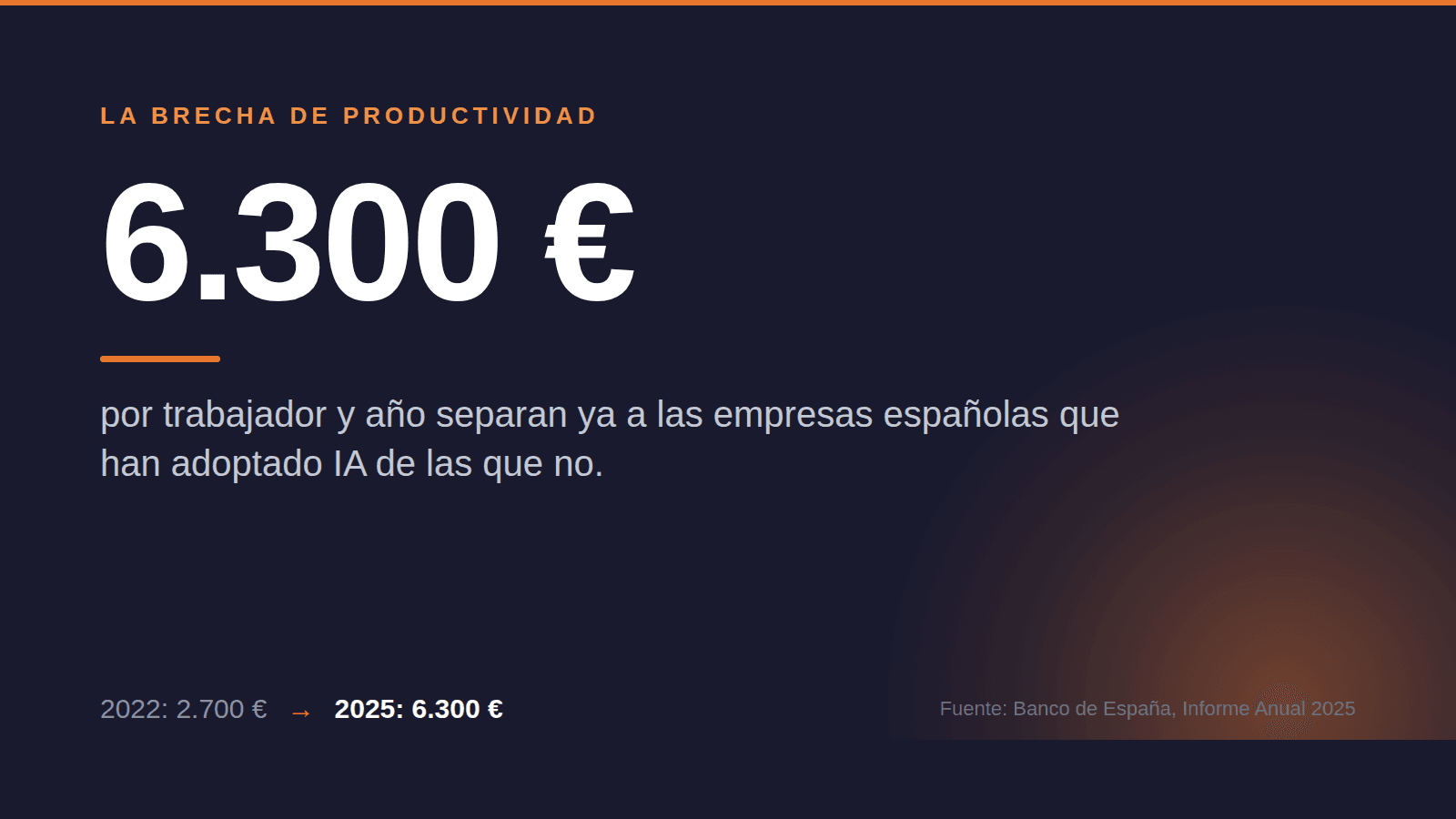
The Bank of Spain has put a price on the gap: 6,300 euros per worker per year. That was the productivity difference in 2025 between Spanish companies that have adopted artificial intelligence and those that have not. In 2022 it was 2,700 euros. It has doubled in three years.
It is an uncomfortable number to look at, especially from the side that hasn't adopted anything yet. But it deserves a careful reading before anyone draws conclusions: who publishes it, what exactly it measures, and above all what the companies on the other side are doing differently. Because the answer has less to do with which AI model they use than with where they put it.

Productivity difference per worker between companies that have adopted AI and those that have not. Source: Bank of Spain, Annual Report 2025.
What the figure measures, and what it doesn't
The number comes from the Bank of Spain's Annual Report, whose productivity chapter sets out why Spanish companies grow less than they could. Before using it as an argument in a board meeting, two caveats that change how it reads:
It is a correlation, not cause and effect. Companies that adopt AI early tend to be larger, more digitised, and to have better management and more qualified staff: factors the report itself identifies as drivers of productivity. Part of those 6,300 euros was there before ChatGPT existed. Nobody should sell you the idea that installing AI equals 6,300 euros more per employee. The Bank of Spain had already looked at this in more detail in an Economic Bulletin article based on its Business Activity Survey: adoption is higher in technology services and among large, productive and young firms, and within the same sector AI use is positively linked to productivity and company size. In other words, to a good extent it is the more productive companies that adopt AI, not only the other way round.
What is hard to argue with is the trend. The distance widens year after year, and the Bank of Spain warns that slow adoption of AI-based technologies will widen it further. The fact that AI doesn't explain the whole difference doesn't mean it can be ignored: it means the advantage compounds through several channels at once, and this is the one moving fastest right now.
Objectivity note: the Bank of Spain doesn't sell AI and has no commercial interest in the result, which makes this one of the cleanest data points available on the subject. In exchange, it is a macroeconomic aggregate: it describes the Spanish economy as a whole, not what would happen inside your company.
How many Spanish companies are already on the other side
The gap stays abstract until you know how many companies sit on each side. According to Spain's national statistics institute (INE) and its survey on ICT and e-commerce use in companies (around 15,000 firms with 10 or more employees, final data published in October 2025) 21.1% of Spanish companies that size were using artificial intelligence in the first quarter of 2025, up 8.7 points on the year before. In services it rises to 25.7%.
Which means four out of five medium and large companies are still on the non-adopting side, while the group that does adopt has grown almost nine points in a single year. The 6,300-euro gap is widening while the leading pack fills up fast.
Meanwhile, AI already supports 30% of tasks
The second figure of this summer comes from a very different place. The Value of AI 2026, produced by Oxford Economics for SAP with 2,600 executives across 13 countries, puts at 30% the share of business tasks AI already performs or assists with, up from 25% the year before. And it projects 48% within two years.

Share of tasks AI already performs or assists with, according to the executives surveyed. Source: SAP and Oxford Economics, The Value of AI 2026.
Objectivity note: the study is published by SAP, which sells software with AI built in, even though the fieldwork is Oxford Economics'. These are perceptions reported by executives, not measurements of actual working time. The direction of the figure is credible and matches what we see in projects; its precision to the percentage point, less so.
The interesting part is what going from 30% to 48% in two years implies. That jump doesn't come from buying more chat licences: it requires putting AI inside processes that today depend on someone copying data from one system into another.
The published ROI is not your ROI
The same report puts numbers on the return, and this is where you want a calculator in hand. Average AI spend among the companies surveyed is around 28 million dollars, with an expected ROI of 21% this year (about 6.3 million), up from 16% the year before, and a forecast of 38% within two years. For agentic AI, the average expectation goes from 4.3 to 17.6 million dollars over the same period.
These are averages for large international corporations. If your company has between 50 and 500 employees, those millions are not your case and shouldn't be used as a benchmark: what's useful is the direction (returns improve as AI stops being a pilot and reaches production) not the magnitude.
It is worth putting next to the obligatory counterpoint: Gartner predicts that more than 40% of agentic AI projects will be cancelled before the end of 2027, due to escalating costs, unclear business value, or inadequate risk controls. Both things are true at once: average returns are rising and nearly half of all projects fall by the wayside. What separates one group from the other is almost never the model.
Where it breaks: 73% have a strategy, fewer than half have an owner
The SAP and Oxford Economics study makes the diagnosis fairly plain:
- 73% of organisations say they have an AI strategy aligned with their business objectives.
- Fewer than half have appointed someone accountable for AI.
- Only 41% train their executives on the technology's capabilities and risks.
- And only 33% include AI adoption indicators in their leadership team's objectives.
A strategy with no owner and no indicator in anybody's objectives isn't a strategy: it's an intention.
It's the same distance the productivity figure shows, told from inside the company. Almost everyone has a plan; far fewer have someone whose job it is to deliver it.
What opens the gap is what sits underneath the model
At Tecnea we see the pattern regularly. A company buys licences for a generative AI tool, hands them out across departments, and six months later can't find the savings anywhere. Not because the tool is bad, but because each person uses it for their own isolated task while the process (the thing that actually consumes hours) carries on exactly as before: someone reads an email, someone copies a figure into the ERP, someone checks that it adds up.
The productivity jump appears when AI touches the whole process, and that depends on two decidedly unglamorous things: data quality and integration with the systems you already have. An invoice that reads itself but still has to be keyed into the ERP hasn't automated anything; it has moved the work somewhere else. An assistant that answers beautifully on general knowledge but knows nothing about your internal procedures is an expensive search engine.
And this isn't our opinion: when the Bank of Spain asks Spanish companies what holds them back from adopting AI, the three obstacles that come up most are the lack of qualified staff, implementation costs, and data unavailability. None of the three is fixed by switching models.
It's the same point we made in why having the most powerful AI model doesn't guarantee results and what sits behind the hidden cost of legacy systems: the competitive advantage isn't in the model, which is a commodity available to anyone, but in the context and the connections only your company has.
What to do with this
- Measure your starting point before buying anything. Revenue per employee, hours spent on repetitive tasks in the two or three processes that consume the most. Without a baseline there's no honest way to tell later whether something worked.
- Pick a process, not a tool. One with volume, reasonably clear rules, and an identifiable owner. Supplier invoices, expense reports, support responses, document review.
- Check the data before the model. If the information in that process lives in three places and doesn't match between them, no model will fix it.
- Put a name on it. An owner and an indicator inside the leadership team's objectives: precisely what two out of three companies in the study are missing.
- Connect before you scale. If the output of the AI needs someone to copy it into another system, the process isn't automated, it's merely assisted.
- Review it at 90 days with the same metric from point 1. If nothing moves, the problem is the use case you chose, not the model.
Frequently asked questions
Will adopting AI give me 6,300 euros more per worker? No. It's an aggregate average difference between two groups of companies, and much of it is explained by prior factors such as size, degree of digitisation, or management quality. What the figure tells you is the direction and the speed at which the distance is widening, not a guaranteed return.
Do we have to start with autonomous agents? Almost never. It's what generates the most headlines and also what accumulates the most cancelled projects, according to Gartner. One well-chosen process delivers sooner and teaches you far more about where the value sits in your case.
What if our systems are old? That's the most common situation and it doesn't stop you from starting, but it does dictate the order: first connect and clean up the data for the process you're going to automate, then add the AI layer. Doing it the other way round is the fast route to a pilot that never reaches production.
How long before we see something? If the process is well chosen, weeks rather than quarters. If no metric has moved after 90 days, the honest move is to change the use case rather than scale the one that isn't working.
If you'd rather put a number on your own case than on the Spanish economy's average, our AI ROI calculator runs the estimate with your figures and shows you the result on screen, without asking for your contact details. And if you'd prefer to go through it together with your processes in front of us, let's talk.
This article is informational. We have tried to state the source of each figure, the methodology where it is known, and whether whoever publishes it has a commercial interest in the result. None of the sources cited belong to Tecnea, which does have a commercial interest in companies integrating AI into their processes — that is precisely what we do.
Sources
- Bank of Spain — Annual Report 2025
- Bank of Spain — Economic Bulletin 2025/Q2: Adoption of artificial intelligence in Spanish firms, an initial analysis based on the EBAE
- INE — Survey on ICT and e-commerce use in companies, final data
- SAP and Oxford Economics — The Value of AI 2026
- SAP News — Business Value of AI Is Spiking, Driven by Increased Adoption and Agentic Expectations
- Gartner — Predicts Over 40% of Agentic AI Projects Will Be Canceled by End of 2027
Did you find this article useful?
We publish analysis on AI and technology for businesses. No spam: only when we write something worth reading.
You can unsubscribe from any email. Privacy policy
Did you like this article?
Tell us what you'd like to automate in your company and we'll tell you, with no strings attached, where to start.


